These free inorganic chemistry books in PDF take you from your first course to graduate topics. Inorganic chemistry studies the elements of the periodic table and their compounds, from metals to minerals.
Each section covers one branch of the course, from transition metals and their complexes to crystals and the metals inside living cells.
The books come from universities and open textbook projects, so they work for a first-year class, a BSc exam or a graduate seminar.
📚
Download every Inorganic Chemistry book on this page
All the books on this page in one ZIP file, instead of downloading them one by one.
We will redirect you to accounts.google.com to complete sign-in.
Email and name only · We never send spam
Access unlocked
Download every Inorganic Chemistry book on this page
All the books on this page in one ZIP file, instead of downloading them one by one.
Direct download · One ZIP file
Download started. Check your downloads folder for the ZIP.
Textbooks
Inorganic Chemistry Textbooks
Start here if you need the whole inorganic chemistry course in one place. These textbooks cover atomic structure, chemical bonding, the main group elements and IUPAC nomenclature.
A complete undergraduate textbook in a compact format. It moves from the elements and bonding theory to main group and transition metal chemistry, organometallics and inorganic reactions.
A first-year university course that starts with atomic structure and periodic properties, then covers chemical bonding and the s- and p-block elements group by group. Each unit closes with review questions.
An open textbook that walks you through the core of inorganic chemistry: atomic structure, bonding models, acids and bases, crystal structures and the chemistry of the main group and transition metals.
A full tour of the main group elements, group by group: hydrogen, the alkali and alkaline earth metals, boron, carbon, nitrogen, oxygen, the halogens and the noble gases, with their properties, compounds and uses.
A course guide for beginners that explains the periodic table and periodic law, then covers hydrogen, the alkali and alkaline earth metals and other main group elements, with self-assessment exercises in every unit.
The second-year follow-up to Inorganic Chemistry I. It covers the three transition series, the lanthanides and actinides, coordination compounds and their isomerism, redox reactions and acid-base theories.
The official IUPAC Red Book with the rules for naming inorganic compounds, from elements and ions to coordination and organometallic compounds. The reference to check when you need the correct name of a substance.
Graduate-level lecture notes on symmetry, group theory and molecular orbital theory applied to metal complexes, followed by problem sets and exams to practice with.
A hands-on lab guide to handling air-sensitive compounds: setting up a Schlenk line, transferring liquids by cannula, drying solvents, freeze-pump-thaw and working in a glovebox, step by step with photos.
Coordination compounds are where the transition metals of inorganic chemistry get interesting. These books explain ligands, isomers and crystal field theory step by step.
A complete open textbook on coordination compounds: ligands, structures and isomers, crystal field and ligand field theory, electronic spectra, magnetism and reaction mechanisms of transition metal complexes.
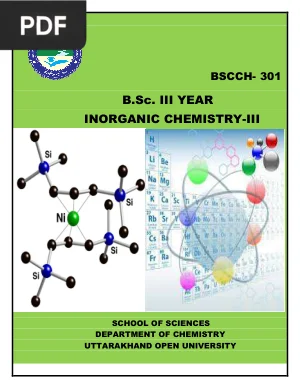
The third-year course that connects coordination chemistry with its applications: HSAB theory, metal-ligand bonding, magnetism and electronic spectra of transition metal complexes, metal carbonyls and an introduction to bioinorganic chemistry.
A master-level course on transition metal complexes. It covers substitution and electron transfer mechanisms, metal-ligand bonding, electronic spectra and magnetic properties of the first transition series.
A university course on coordination compounds that explains Werner theory, nomenclature, isomerism, valence bond and crystal field theories and the stability of complexes, with exercises at the end of each unit.
Lecture notes from a final-year course that compares valence bond, crystal field and ligand field theories, reads structure from spectra and magnetic data, and explains reaction mechanisms in octahedral and square planar complexes.
Organometallic chemistry is the bridge between inorganic and organic chemistry. Here you'll learn the 18-electron rule and how metal catalysts drive industrial reactions.
A clear introduction to organometallic chemistry: the main ligands, electron counting, geometry of complexes and the key reactions, from oxidative addition to migratory insertion and beta-elimination.
Covers organometallic compounds across the periodic table, from lithium, magnesium and boron to transition metal alkyls, hydrides, carbonyls and phosphine complexes, with the 18-electron rule and Ziegler-Natta catalysts.
The full lecture notes of a graduate organometallic course, with detailed mechanisms for hydrogenation, hydroformylation, polymerization and Pd-catalyzed coupling. Ideal if you want to understand how catalysts really work.
A master-level course on stereochemistry and bonding in main group compounds, followed by metal pi-complexes, metal carbonyls, nitrosyls and metal clusters.
Solid state chemistry studies how atoms pack into crystals and why that shapes a material. These books cover crystal structures, defects and X-ray diffraction.
The complete MIT course on solid state chemistry: crystal structures, X-ray diffraction, defects, glasses, diffusion and phase diagrams, with self-assessments, quizzes and exams.
A master-level course on crystal lattices and unit cells, solid state reactions, defects, organic solids and fullerenes and diffraction techniques, plus liquid crystals and surfactants.
Lecture slides from an advanced inorganic chemistry course that explain close packing, basic crystallography and how to read complex crystal structures, with many structure diagrams.
Iron carries the oxygen in your blood, and zinc keeps hundreds of enzymes working. These bioinorganic chemistry books explain how metalloproteins make life possible.
The classic graduate textbook on how metals work in living systems: storage and transport of iron, zinc enzymes, calcium, oxygen carriers, electron transfer proteins and metals in medicine.
Ivano Bertini, Harry B. Gray, Stephen J. Lippard and Joan S. Valentine
A master-level course whose first block covers metal ions in biology, metalloproteins and metalloenzymes, then connects them to enzyme chemistry and the physical chemistry of biomolecules.
Study material for a master-level course that covers metal transport and storage, zinc, iron and copper enzymes, hemoglobin and myoglobin, cytochromes, nitrogen fixation and photosynthesis.
A visual handout that reviews the coordination chemistry you need first, then explains how cells take up, transport and store iron and how sodium, potassium and other ions work in biology.
Send this page to someone who’d love to read it. Everything is free, no sign-up needed.
Esc
Start typing to search...
Searching...
No results found
Try different search terms
Your book is downloading!
If InfoBooks helped you, you can support us in one click: add us as a preferred source on Google. You'll see more of our books when you search, and you'll help us keep sharing free reading with everyone.
Done! Your book is downloading
Know someone who’d enjoy reading it? Send them this page. It’s free, no sign-up needed, and you help us spread the love of reading.