These free Immanuel Kant books cover the work of the German philosopher who redrew the limits of human knowledge. He was born in Königsberg, Prussia, in 1724, and barely left that city his whole life.
You will find the three Critiques here, plus shorter essays on ethics, politics, religion, and education. Kant's central ideas are all present: transcendental idealism, the categorical imperative, and the motto that defined the Enlightenment.
Every book here is free to read online or download as a PDF, with no registration. Start with something short like What Is Enlightenment? before working up to the first Critique.
📚
Download every book on this page in one click
Sign in with Google and grab them all without going one by one.
We will redirect you to accounts.google.com to complete sign-in.
Email and name only · We never send spam
Access unlocked
Download every book on this page in one click
Get them all together, without going one by one.
Direct download · One ZIP file
Download started. Check your downloads folder for the ZIP.
Metaphysics
Immanuel Kant Metaphysics and Knowledge Books
These are the free Immanuel Kant books where he asks what the mind can actually reach. Start with the Prolegomena if the first Critique looks too steep.
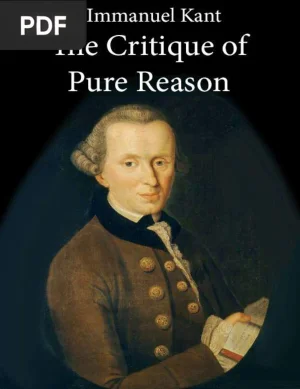
Kant asks what the mind can know before experience begins, and where reason runs out of road. Dense and demanding, but this is the book that split philosophy into before and after.
Kant rewrote his own hardest book here after readers found the first Critique impenetrable. The clearest statement of transcendental idealism he ever produced, and the right place to start.
Kant's 1770 inaugural dissertation, where he first separates what the senses deliver from what the intellect supplies. Short, and the seed of everything the Critiques would later build.
Kant takes on Swedenborg's ghost visions and uses them to expose how easily metaphysics drifts into fantasy. Sharp, funny, and unlike anything else he wrote.
Kant built morality on reason instead of feeling or reward. These Immanuel Kant books lay out the categorical imperative and what duty actually demands.
The book that introduced the categorical imperative and made duty, not consequence, the test of a good act. Short enough to read in a sitting and still the standard entry point to Kantian ethics.
Kant builds morality out of reason alone, with no appeal to feeling, reward, or religion. The second Critique, and his fullest defense of why free will and moral law belong together.
The virtue half of the Metaphysics of Morals, where Kant works out what duty actually demands day to day. Covers duties to yourself and to others, from self-respect to friendship.
The justice half of the Metaphysics of Morals, covering property, contract, punishment, and the authority of the state. Completes the picture that the ethics volume only half tells.
These Kant books cover how he reasoned and how he explained the physical world. Logic sets the rules of thought, and natural science applies them to matter and motion.
Kant's lectures on how to reason without fooling yourself, covering concepts, judgments, and the sources of prejudice. Includes his separate essay on the mistaken subtlety of the four syllogistic figures.
A full course in Kant's logic, from the nature of knowledge to the rules governing valid inference. Broader than the shorter introduction and useful if you want the complete lecture cycle.
Kant applies his critical method to physics, deriving the concepts of matter, motion, and force from first principles. Modernized English edition that makes one of his most technical works readable.
Kant's theory of how the solar system formed from a rotating cloud of matter, proposed decades before astronomers caught up with him. Includes his essay on the slowing rotation of the earth.
Six pages that gave the Enlightenment its motto: dare to know. Kant argues that what keeps people intellectually dependent is not lack of intelligence but lack of nerve.
Kant's blueprint for how states could stop going to war, built on republican constitutions and a federation of free nations. The essay that shaped modern thinking on international law.
Kant argues that history has a direction, and that human conflict itself is what drives societies toward justice. A short essay with an unusually large claim.
Kant's political writings gathered in one volume, covering the principles of political right alongside his essay on perpetual peace. The best single collection of his thinking on law and the state.
Kant argues that publishing someone's work without permission wrongs the author as a speaker, not just as an owner. A short essay that reads as an early theory of intellectual property.
Kant asks why a judgment of taste feels universal when beauty cannot be proven, then turns to purpose in nature. The third Critique, and the bridge between his work on knowledge and his work on morality.
Kant tests how much of religion survives when you keep only what reason can support. The book that got him censored, and his most direct account of radical evil and moral faith.
Kant's lectures on education with commentary, covering discipline, culture, and the formation of moral character. Argues that children should be taught to reason rather than to obey.
The direct translation of Kant's lectures on pedagogy, on raising a person capable of thinking independently. Shorter and more focused than the annotated edition.