Looking for Portuguese books for children? Here are 29 free Portuguese books for children in PDF, sorted by age: fairy tales, illustrated classics, poetry, and Brazilian children's literature.
Reading in Portuguese early does what no workbook can. The vocabulary and the grammar arrive wrapped in a story, told by Collodi, Lewis Carroll, Beatrix Potter, and Monteiro Lobato, the great name of Brazilian children's literature.
Pick the age range that fits your reader. Every book is free to read online or download as PDF, one at a time or all at once in a single ZIP.
📚
Download every Portuguese book for children on this page
All the books on this page in one ZIP file, instead of downloading them one by one.
We will redirect you to accounts.google.com to complete sign-in.
Email and name only · We never send spam
Access unlocked
Download every Portuguese book for children on this page
All the books on this page in one ZIP file, instead of downloading them one by one.
Direct download · One ZIP file
Download started. Check your downloads folder for the ZIP.
Ages 4 to 6
Portuguese Books for Ages 4 to 6
The contos de fadas of the Brothers Grimm and Charles Perrault arrive in Portuguese here, in short illustrated editions you can finish in one sitting. The poems of Olavo Bilac and O Pequeno Príncipe round out the group, two gentle ways to let the language in through the ear.
An illustrated retelling of the classic tale in Portuguese, built for reading aloud together. Sixteen pages pair full colour artwork with short sentences, so a child who is just starting out can follow the story through the pictures.
The story of the girl who loses a slipper at the ball, told in Portuguese with full page illustrations. It belongs to a collection designed for shared reading, with concrete vocabulary and short sentences.
A clever cat turns his penniless owner into a marquis through sheer cunning. This Portuguese adaptation gives every scene its own illustration, so the plot stays clear even before a child reads fluently.
The duckling nobody wants grows up to discover he was always a swan. This Portuguese version keeps the tale to its essentials and leans on large illustrations, which makes it work well as a first read aloud.
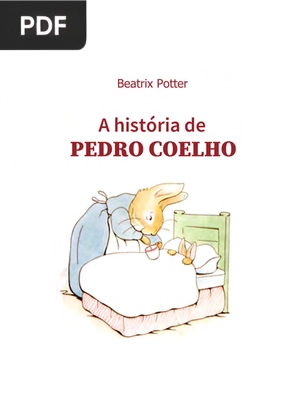
An illustrated tale in Portuguese about a mischievous young rabbit who ignores his mother and sneaks into the forbidden vegetable garden. The author's original watercolours run alongside a short text, ideal for reading aloud to children who cannot yet read on their own.
Short poems written originally in Portuguese by one of the great names of Brazilian poetry. Rhyme and rhythm let the language in through the ear, something no prose story manages as easily at this age.
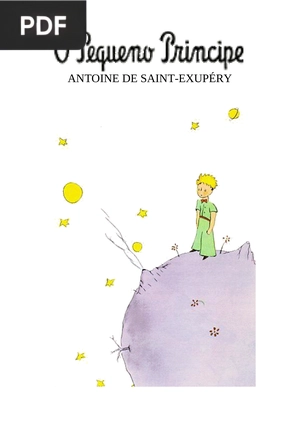
A pilot stranded in the desert meets a boy who arrived from another planet. This Portuguese edition keeps the author's watercolours and the fable like tone that turned the book into shared reading for children and adults alike.
At this age a book with chapters is no longer too much, and Portuguese stops being a subject and becomes the language the adventure happens in. Pinóquio, Alice, and the Peter Pan that Monteiro Lobato retold share the shelf with Reinações de Narizinho and the collected tales of Grimm, Andersen, and Aesop.
The adventures of the wooden puppet who wants to become a real boy, translated into Portuguese and illustrated. The chapters are short and each one closes an episode, so it can be read a little at a time without losing the thread.
Alice follows a hurried rabbit and falls into a world where nothing obeys logic. The Portuguese translation keeps the wordplay and the nonsense humour that made the book a classic.
The story of the boy who refused to grow up, retold in Portuguese by Monteiro Lobato in the voice of Dona Benta. It is not a literal translation but a Brazilian version, with the spoken tone of someone telling a story to the children around her.
A compilation of the Brothers Grimm tales in Portuguese, illustrated with engravings by Arthur Rackham, Walter Crane and Gustave Doré. It gathers the best known stories in a single file, handy for picking one a night.
A selection of Andersen tales in Portuguese, including The Princess and the Pea, The Emperor's Nightingale, Thumbelina and The Steadfast Tin Soldier. Each story stands on its own and runs only a few pages.
The Greek animal fables that end in a moral, gathered in Portuguese and illustrated. Each one runs under a page, which makes them comfortable material for practising the language without committing to a long read.
The book that opens the Sítio do Pica-Pau Amarelo, where Narizinho, Emília and Dona Benta build the best loved children's universe in Brazilian literature. Complete illustrated edition, with short episodic chapters.
An orphaned girl arrives at an English manor and finds a garden that has been locked for ten years. The Portuguese translation keeps the unhurried pace of the original, where the garden changes at the same time as the characters.
Mowgli raised by wolves, along with Baloo, Bagheera and the tiger Shere Khan, in Portuguese translation. Beyond the jungle stories it also collects other animal tales by the same author.
Pre-adolescence asks for long plots, and these Portuguese novels have them. Mark Twain, Louisa May Alcott, and Lucy Maud Montgomery write protagonists the same age as the reader, and Viagem ao Céu adds the Brazilian note to a group of translated classics.
A horse tells his own life in the first person as he passes from owner to owner through Victorian England. The novel was written to make people treat animals better, and it still works that way.
A tornado carries Dorothy to a land where the scarecrow, the tin woodman and the lion all talk. The Portuguese translation includes the author's introduction, where he explains why he wanted to write a fairy tale without the darker morals.
A condensed Portuguese version of the pirate novel, with the map, the Admiral Benbow inn and Long John Silver. Being a short adaptation, it works as a first approach before taking on the full text.
Tom Sawyer, Huckleberry Finn and the town on the banks of the Mississippi, in Portuguese translation. Between the whitewashed fence, the graveyard at night and the cave, the novel moves in episodes that read almost like separate stories.
Sara Crewe goes from privileged pupil to servant at a London boarding school when her father dies ruined. A Portuguese translation from the same author as The Secret Garden, in the same register.
A pair of elderly siblings ask for a boy to help on the farm and receive Anne, a red haired girl who never stops talking. The Portuguese translation keeps the humour and the intensity of its main character.
The four March sisters grow up during the American Civil War while their father is away at the front. The Portuguese translation follows each of them separately, with Jo and her calling as a writer at the centre.
The children of the Sítio do Pica-Pau Amarelo travel the solar system on pirouette powder. Written originally in Portuguese, it mixes adventure with astronomy, and this edition also includes O Saci.
Here Portuguese is a reading language and not an exercise. Jules Verne, Jonathan Swift, and Mark Twain ask for sustained attention and give back travel, satire, and adventure, which makes them the bridge between children's reading and the adult novel.
Huck escapes from his father and floats down the Mississippi on a raft with Jim, a runaway slave. It is narrated in the first person in a boy's voice, and the Portuguese translation works to hold that tone.
Five siblings find a bad tempered sand fairy who grants one wish a day, and every wish goes wrong. The Portuguese translation keeps the author's dry humour.
The complete text of Gulliver's four voyages in Portuguese, not just Lilliput and Brobdingnag. Beneath the adventure there is a political satire that turns sharper in the last two parts.
Phileas Fogg bets he can travel around the world in eighty days and leaves London that same night. The Portuguese translation sustains the stopwatch pace that defines the novel.
A courier of the tsar crosses Siberia carrying a message that cannot fall into enemy hands. It is the most tense of Verne's novels and the Portuguese translation keeps the dramatic weight of the journey.