Geometry books can be expensive, but the field has a long tradition of open and public-domain texts. This page collects 29 free geometry textbooks in PDF for students, teachers, and self-learners who want to study lines, polygons, circles, conics, and the Euclidean plane without paying.
You'll find textbooks for every level and every branch of the field. The collection covers Euclidean and plane geometry, differential geometry, analytic and coordinate geometry, projective and non-Euclidean geometry, plus problem workbooks and formula references.
Pick a section below to jump straight to the books that match your level, or download the entire collection as a ZIP from the button above. No signup, no email, no paywall.
📚
Download every Geometry book on this page
All the books on this page in one ZIP file, instead of downloading them one by one.
We will redirect you to accounts.google.com to complete sign-in.
Email and name only · We never send spam
Access unlocked
Download every Geometry book on this page
All the books on this page in one ZIP file, instead of downloading them one by one.
Direct download · One ZIP file
Download started. Check your downloads folder for the ZIP.
Fundamentals
Books on Geometry Fundamentals
These geometry books are where most readers begin. They cover the language and core theorems that every other branch builds on.
Lecture notes from Texas Tech that build geometry from absolute axioms through Euclidean and non-Euclidean systems. Solid pick for math undergraduates moving past school geometry.
Teacher edition of CK-12's open Basic Geometry text. Each chapter pairs with student materials and includes notes on common errors, pacing, and classroom activities.
College geometry course from the University of South Carolina that walks through Euclidean and non-Euclidean systems with Geometer's Sketchpad as a working tool. Strong on visual proofs and explorations.
Open textbook from City University of New York covering lines, angles, triangles, similarity, and trigonometry. The 2021 edition adds corrections and new diagrams, making it one of the most polished free college geometry books.
Rigorous treatment of geometry built on Hilbert's axioms, starting from incidence and betweenness and reaching the parallel postulate in 256 pages. Best read after a first course in Euclidean geometry.
Open textbook prepared for the African Virtual University by Marcos Cherinda, with chapters on synthetic Euclidean geometry, transformations, and applications drawn from ethnomathematics.
Wikibooks elementary geometry text built around classical constructions with ruler and compass. Walks through congruence, the Pythagorean theorem, and basic triangle results at a school-friendly pace.
Radford University course material on Euclidean geometry, axiomatic systems, and triangle trigonometry. Builds from points and lines to a working knowledge of right-triangle problems.
First-year geometry course at the University of Warwick by Timothy Logvinenko. Traces geometry from its measurement origins to the axiomatic method, with worked proofs and exercises throughout.
Euclidean geometry is the 2,300-year-old foundation of the field. These titles walk through axioms, congruence, similarity, and the classical results that still anchor every high school and college course.
Hilbert's classic 1902 treatise translated by E. J. Townsend, the work that put modern axiomatic geometry on solid ground. Still essential reading for anyone studying the foundations of mathematics.
AMSI TIMES guide for Years 7-8 covering the basic objects of plane geometry: points, lines, angles, and the first results about parallel lines and triangles.
Modern, minimalist introduction to Euclidean and neutral geometry built up from the metric-space approach. Covers inversions, hyperbolic geometry, and the foundations of non-Euclidean ideas with full proofs and exercises.
Classic 1911 plane and solid geometry textbook from the University of Chicago that pairs each theorem with worked problems and applications. Covers congruence, similarity, areas, volumes, and the regular solids.
Wentworth and Smith's classic plane geometry text, the standard high school book of its era. Builds Euclidean geometry from postulates through congruence, parallels, circles, similar figures, and area in clear sequential steps.
Differential geometry uses calculus to study curves and surfaces. These books are aimed at undergraduates and graduate students who already have a base in linear algebra and multivariable calculus.
Graduate-level treatise on differential geometry built around natural operations and jet bundles. Aimed at researchers and PhD students with a strong base in manifolds and Lie groups.
Lecture notes on curves and surfaces from Aalborg University, with computer visualizations linked from the text. Good entry to differential geometry for math students with vector calculus under their belt.
M.Sc. Mathematics course material on differential geometry from Alagappa University, organized by units with worked examples on curves, surfaces, and the first and second fundamental forms.
Analytic geometry connects algebra with geometric shapes through coordinates. Expect chapters on lines, conic sections, and 3D space, with the algebraic methods that make calculus possible.
Teacher guide from the AMSI TIMES project on Years 9-10 coordinate geometry. Covers the Cartesian plane, distance and midpoint formulas, gradients, and the equations of lines.
Open textbook from Bashkir State University covering vectors, coordinate systems, the line and plane in space, conic sections, and quadric surfaces. Designed for first-year math and physics students.
Comprehensive 1921 analytic geometry treatise by two Harvard mathematicians, taking the reader from coordinates and the straight line through conics to the analytic geometry of three-dimensional space.
Soviet classic problem book on analytic geometry edited by N. V. Yefimov. Hundreds of exercises on lines, planes, conics, and three-dimensional coordinates, each with full answers at the back.
These are the geometries that emerged when mathematicians questioned Euclid's fifth postulate. Hyperbolic, elliptic, projective, and tropical geometry all live here.
Graduate text on tropical geometry by two researchers active in the field, with chapters on tropical curves, hypersurfaces, and the link to classical algebraic geometry. For readers comfortable with algebraic varieties.
Linfield College textbook that approaches geometry through the question of the shape of the universe. Covers Euclidean, hyperbolic, and elliptic geometry on the way to a primer on cosmic topology.
Concise 27-page introduction to projective geometry from a Master MOSIG course, covering projective spaces, transformations of the line and plane, and conics in the projective setting.
Five-page handout with the perimeter, area, and volume formulas for the figures every geometry course returns to. Useful as a quick refresher before exams or while working through longer texts.
Arizona State University study notes on perimeter, area, and the Pythagorean theorem, with worked word problems on each topic. Useful as a focused review of school-level results.
Theory is half the work. These problem sets and workbooks turn the concepts in the textbooks above into the fluency you only get from doing the exercises.
Classroom Challenge lesson from the Mathematics Assessment Project on geometric properties of circles and triangles. Includes student tasks, sample solutions, and teacher commentary.
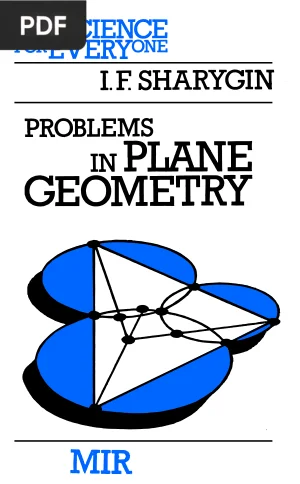
Sharygin's landmark collection from the Mir Science for Everyone series, with over 600 plane geometry problems on triangles, circles, and quadrilaterals. Detailed solutions and hints turn each problem into a small lesson.
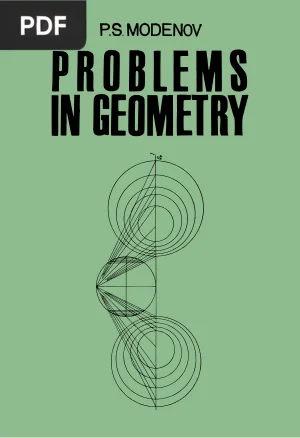
Wide-ranging problem collection by Modenov spanning plane and solid geometry, transformations, and analytic methods. Solutions are worked in detail, making it useful for self-study and olympiad preparation alike.
These 29 geometry books cover every major branch of the field, from the ancient axioms of Euclid to modern projective and tropical spaces. Pick one that matches your background, then work through the problems to make the concepts stick.