These free rationalism books in PDF explain the philosophy that puts reason first. You will find classic works, clear introductions and short academic papers.
Rationalism says some knowledge comes from reason alone, not from the senses. Its thinkers defended innate ideas and a priori truths, like the truths of math.
The great rationalists of the 17th century were René Descartes, Baruch Spinoza, Gottfried Leibniz and Nicolas Malebranche. Here you can read their own works for free.
📚
Download every Rationalism book on this page
All the books on this page in one ZIP file, instead of downloading them one by one.
We will redirect you to accounts.google.com to complete sign-in.
Email and name only · We never send spam
Access unlocked
Download every Rationalism book on this page
All the books on this page in one ZIP file, instead of downloading them one by one.
Direct download · One ZIP file
Download started. Check your downloads folder for the ZIP.
Introductions
Rationalism Books
These rationalism books give you the big picture, from a clear university guide to sharp critiques. Start with the IGNOU study block if you are new to the topic.
A clear university study block on the three great rationalists: Descartes, Spinoza and Leibniz, closing with a critical evaluation of rationalism. Each unit comes with key terms and check-your-progress questions, ideal if you are new to the topic.
From Parmenides to the Renaissance, this article traces the rationalist idea that the universe itself has a rational structure, and what happens when thinkers push back against it. Open access under CC BY.
Michael Rosen questions the rationalist ideal of the self-directing individual without giving up on reason itself. A sharp essay for anyone who wants to hear the strongest case against rationalism.
A full doctoral thesis that tests whether reason alone can tell us what is possible and what is necessary. A demanding but rewarding read if you want to see how rationalism is argued about in philosophy today.
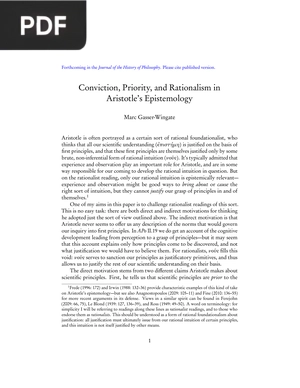
Was Aristotle a rationalist who trusted pure intuition, or did he think experience could justify first principles? This paper challenges the rationalist reading of Aristotle and shows why the question still matters.
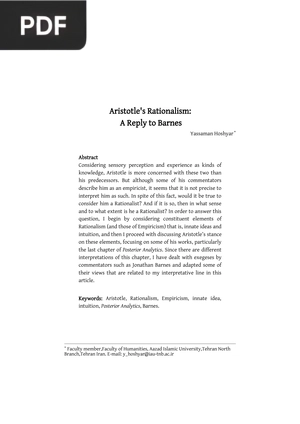
Innate ideas, intuition and the Posterior Analytics: this article asks in what sense Aristotle can be called a rationalist, answering Jonathan Barnes' empiricist reading.
Here are the original works of continental rationalism, written by Descartes, Spinoza, Leibniz and Malebranche. All are public domain translations you can read for free.
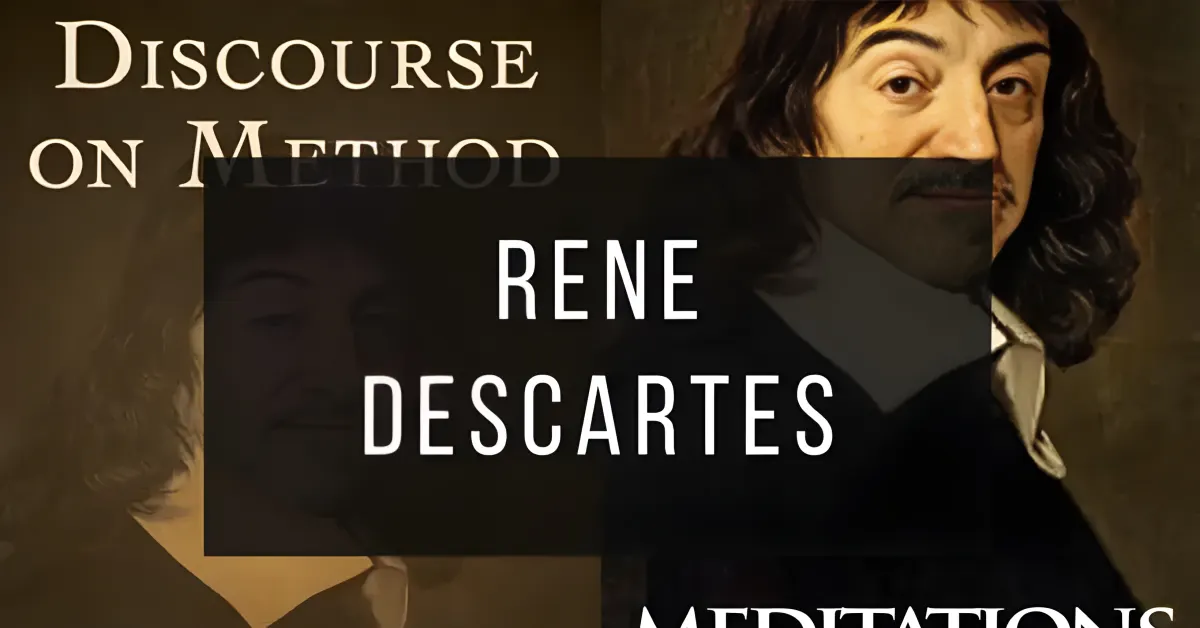
The six meditations where Descartes doubts everything he knows until he reaches a certainty he cannot doubt. This edition adds short bracketed explanations, so the argument is easy to follow step by step.
Descartes tells how he decided to doubt everything and rebuild knowledge from a single certainty: I think, therefore I am. The short, personal book that launched modern rationalism.
Descartes' own textbook version of his philosophy, from the method of doubt to the nature of God, mind and matter. John Veitch's classic translation, typeset in a clean modern layout.
Spinoza builds his whole philosophy like geometry, from definitions and axioms to God, mind, emotions and freedom. The most ambitious system of 17th-century rationalism, in the classic Elwes translation.
Spinoza reads the Bible with the tools of reason and defends freedom of thought against religious and political authority. The book that made him the most controversial philosopher of his time.
In just 90 short paragraphs, Leibniz describes a universe made of simple substances, the monads, in perfect pre-established harmony. The most compact summary of his philosophy, in Robert Latta's translation.
The first mature statement of Leibniz's philosophy, together with his famous correspondence with Arnauld and the Monadology. An essential volume to understand how Leibniz thought reason explains everything.
Leibniz answers John Locke chapter by chapter, defending innate ideas against the blank slate. The great rationalist reply to empiricism, in the complete 1896 Langley translation.
Malebranche, the great French rationalist after Descartes, explains his idea that we see all things in God through a lively conversation between a teacher and his student. The best way into his thought, in Morris Ginsberg's translation.
Do we know the world through reason or through experience? These books compare the rationalists with Locke, Berkeley and Hume, and show how Kant tried to join both sides.
An open textbook that puts the rationalists and the empiricists side by side: Descartes, Spinoza and Leibniz against Locke, Berkeley and Hume, ending with Kant. Primary texts come with short introductions and study questions.
Hume woke Kant from his dogmatic slumber, and this is Kant's answer: a short guide to how reason and experience work together. The clearest way to see how he tried to settle the rationalism versus empiricism debate.
Where does the textbook story of rationalists against empiricists come from? This paper shows how Kant invented that way of telling the history of modern philosophy.
A compact comparison of the two great schools of modern epistemology: how each explains the origin of knowledge, the role of the senses and the power of reason. Open access under CC BY.
Do moral facts give us reasons to act? Michael Smith maps three versions of moral rationalism and argues for the most plausible one. A clear entry point into the contemporary debate.
Kant argues that reason alone, not feelings or consequences, tells us what we ought to do. The book that introduced the categorical imperative and the boldest statement of moral rationalism.
The Cambridge Platonist Ralph Cudworth argues that right and wrong are as unchangeable as the truths of geometry, not mere commands of God or the state. A founding text of moral rationalism, in the original 1731 edition.
Richard Price answers Hume and the moral sense theorists: our ideas of right and wrong come from the understanding, not from feeling. The classic case for rational intuitionism in ethics, in the 1769 second edition.
These books follow how rationalism spread from ancient Greece to the Enlightenment. You will see how reason slowly challenged superstition and authority in Europe.
A short, lively history of rationalism as the habit of testing every belief by reason, from ancient Greece to modern freethought. A quick read that gives you the big picture in an afternoon.
Why did Europe stop burning witches and believing in miracles? Lecky's classic history follows how the spirit of reason slowly replaced superstition, starting with magic, witchcraft and miracles.
The second volume of Lecky's history covers religious persecution, the secularization of politics and the rise of industry. It shows how trusting reason over authority changed laws, governments and everyday life.
The great historian J.B. Bury tells the long struggle of reason against authority, from Greek philosophers to the age of rationalism and modern science. Short, clear and still one of the best introductions to the subject.
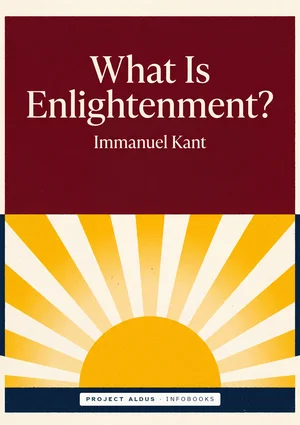
The short essay that gave the Enlightenment its motto: dare to know, have the courage to use your own reason. Our own Project Aldus edition, a few pages you can read in one sitting.
How did Western rationalism begin, according to its most famous critic? This paper retells Paul Feyerabend's story of the rise of reason in ancient Greece and compares it with Karl Popper's account.
A short, readable overview of how Plato, Aristotle and the Stoics used reason to think about politics, and how their ideas still shape Western government.
Essays by Justice R.A. Jahagirdar on rationalism as a way of life, with portraits of freethinkers like Socrates, Robert Ingersoll, Charles Bradlaugh and Annie Besant. A lively look at the rationalist movement and its fight for social progress.
Send this page to someone who’d love to read it. Everything is free, no sign-up needed.
Esc
Start typing to search...
Searching...
No results found
Try different search terms
Your book is downloading!
If InfoBooks helped you, you can support us in one click: add us as a preferred source on Google. You'll see more of our books when you search, and you'll help us keep sharing free reading with everyone.
Done! Your book is downloading
Know someone who’d enjoy reading it? Send them this page. It’s free, no sign-up needed, and you help us spread the love of reading.