Our collection of basic engineering books in PDF brings together the fundamentals every engineer needs. You will find math, physics, thermodynamics, chemistry, and materials all in one place.
Basic engineering is the stage where a project's core specifications take shape. It sits between conceptual design and detailed engineering.
Explore more than 30 free engineering fundamentals titles and download as many as you need. It is free, fast, and ready for any device.
📚
Download every Basic Engineering book on this page
All the books on this page in one ZIP file, instead of downloading them one by one.
We will redirect you to accounts.google.com to complete sign-in.
Email and name only · We never send spam
Access unlocked
Download every Basic Engineering book on this page
All the books on this page in one ZIP file, instead of downloading them one by one.
Direct download · One ZIP file
Download started. Check your downloads folder for the ZIP.
Foundations
Basic Engineering Books
These titles introduce what engineering is and how its core concepts apply across every field. Start here if you are new to the discipline and want a solid overview before going deeper.
A short overview that defines what engineering is and traces how the discipline branches into its many specialized fields. A clear starting point if you are new to the subject.
Covers the core engineering mathematics every technician needs, from SI units and metric conversions to fractions, areas, and the perimeter of common shapes. Practical and example driven.
Introduces the fundamentals of process engineering, including units of measurement, concentrations, and mass and energy balances. A concise primer for students entering the field.
A guide to the main engineering branches and the career paths each one opens, from civil and electrical to chemical and mechanical. Useful if you are deciding which direction to take.
These thermodynamics books in PDF cover heat, energy, and the laws that govern them. They are among the most studied fundamentals in any engineering program.
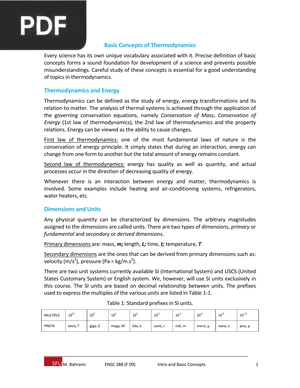
Lays out the vocabulary and first principles of thermodynamics, including the conservation laws and the relationship between energy and matter. A compact reference for the foundations.
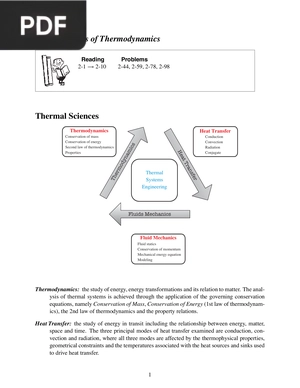
Frames thermodynamics within the wider field of thermal sciences and explains how the conservation of mass and energy and the second law govern thermal systems. Clear and well organized.
A full set of digital notes covering the laws of thermodynamics, properties of pure substances, steam tables, and power and refrigeration cycles. Thorough coverage for a first course.
Works through the laws of thermodynamics, entropy, the properties of pure substances, and the analysis of power and refrigeration cycles. Includes course objectives and outcomes.
These books on mechanical engineering explain forces, motion, and energy conversion. They give you the groundwork before moving on to more advanced topics.
A wide ranging introduction that connects mechanics, materials, fluids, and thermodynamics through worked examples and engineering judgment. One of the most complete free texts on the subject.
Introduces steam boilers and turbines, internal combustion engines, and the foundations of mechanical power. A practical overview of how energy systems work.
Presents the building blocks of mechanical engineering, starting with thermodynamics, heat, and work, then moving through the field's key concepts. Concise and approachable.
These chemical engineering books cover principles, calculations, and the thermodynamics behind chemical processes. They are a strong base for anyone starting in the field.
Explains material balances and the calculations at the heart of chemical engineering, with strategies for single and multiple unit processes. Strong on problem solving method.
A clean, well structured treatment of thermodynamic properties, equilibrium, and the laws as applied to chemical systems. Includes a helpful symbol dictionary.
Course notes on fluid statics and dynamics, compressible flow, flow past immersed bodies, and the transport and metering of fluids. Practical and applications focused.
Covers fundamental concepts, the laws of thermodynamics, and their application to chemical processes, with attention to ideal and real gases. Detailed lecture notes.
A comprehensive introduction to electric circuits and the fundamentals of electrical and electronics engineering. Broad coverage for a first year course.
Lecture notes spanning electric circuits, electromagnetism, DC and AC machines, and measuring instruments. A solid foundation in both electrical and electronic topics.
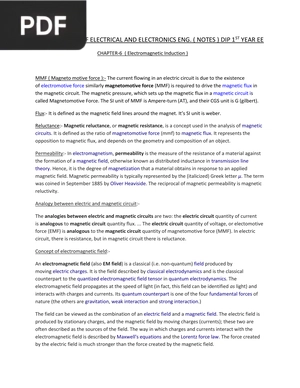
Explains the core ideas of electromagnetism, including magnetomotive force, flux, reluctance, and permeability. Useful supporting notes on electrical fundamentals.
Explores the relationship between the structure and properties of materials and how that knowledge guides engineering design. A thorough introduction to materials science.
Focuses on how engineers choose materials based on mechanical loads, wear, thermal and electrical properties, availability, and cost. A practical guide to selection.
Introduces materials science as the study of how materials are discovered, designed, and applied, from metals and ceramics to advanced materials. A clear overview.
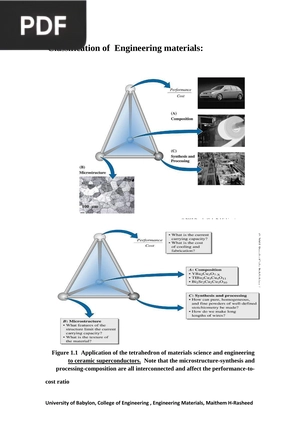
Explains how engineering materials are grouped into metals, ceramics, polymers, semiconductors, and composites, with examples and properties. A concise classification primer.
These engineering physics books apply the laws of physics to real engineering problems. They cover mechanics, energy, and the science behind every design.
Lecture notes that build the physics foundation behind engineering, showing how core principles drive modern technology. Well suited to a first semester course.
Covers vectors and kinematics, simple harmonic motion, heat and thermodynamics, optics, electromagnetism, and modern physics. Broad unit based coverage.
Lecture notes on dielectric and magnetic properties, lasers, quantum mechanics, and engineering materials such as semiconductors. Strong on applied topics.
These engineering mathematics books give you the calculus, algebra, and problem-solving tools engineers use daily. They range from basic to higher-level math for students.
A clear, beginner friendly course that builds engineering mathematics from the ground up, with worked examples and exercises throughout. An ideal starting point for the essentials.
A thorough textbook covering the calculus, algebra, and analysis that first year engineering students need, with plenty of solved problems. Comprehensive and exam oriented.
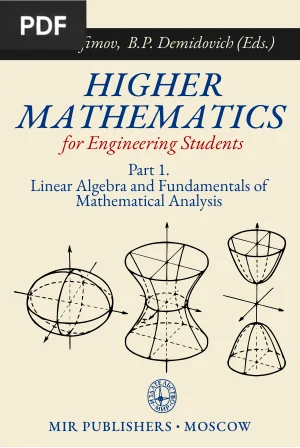
A rigorous treatment of linear algebra and the fundamentals of mathematical analysis aimed at engineering students. A respected classic with clear explanations and figures.